
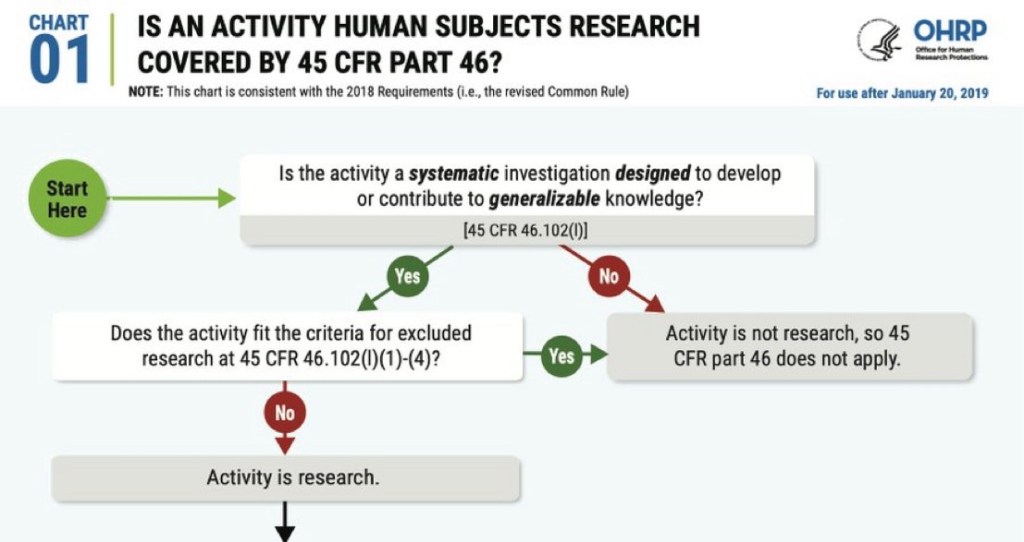
One criticism, which I suggest to serve as a proposed addendum to The Belmont Report’s updated 2018 decision charts in requesting human subjects research, is that in order for research to be fit for IRB review, it must first “contribute to generalizable knowledge”.
This requirement, as it stands, may inadvertently permit unethical scientific inquiry due to its vagueness. It could lead to oversight or exploitation driven by ignorance, lack of ethical consideration, or merely as a loose guideline for human subject research principles – going against the very principles structured within The Belmont Report.
I propose the language be more fit for ethical considerations that safeguard human subjects from contributing through ignorance, their participation in research used for bioweapons or advanced cell fusion/chimeric studies. The results of unscrupulous scientific activities could lead to prolific abuses on or against mankind now or in the future.
Knowing the subjects in this case are human, do we not have a responsibility to protect our own species from potential harms or abuses? This should at the very least warrant speculative inquiry into the exact language required to safeguard mankind from unethical research. Should the current language stand, we may continue to fall captive to an old and continuous system of scientific improprieties against the public. In light of recent examples (such as c19, mRNA vaccines in food supply, genetically engineered mosquitos) the potential harm that could result from manipulating this wording is possible. Particularly in cases where ‘generalizable knowledge’ is convenient for the benefit of a single entity (private or government), which reach IRB approval despite social ethical concerns (gain-of-function research, gene editing, cloning, etc.).
 Ethics On Edge
Leave a comment